Conferences
Report on EASP Meeting: Social Dynamics of Climate Policy and Sustainable Transformation – Acceptance, Conflict and Cooperation
27th-29th June 2026, University of Hohenheim, Stuttgart, Germany
Organizers: Kevin Winter (1), Laura Henn (1), Adrian Lüders (1), Leonie Ströbele (1), Ronja Gerdes (2)
(1) University of Hohenheim, (2 ) Leuphana University Lüneburg
The transition toward sustainable societies is not only a technological challenge but also a deeply social one. How do different communities respond to climate policies? What drives polarization or cooperation in environmental debates? How can trust in key stakeholders be strengthened to foster effective action? These and related questions were at the heart of our EASP-funded Small Group Meeting on “Social Dynamics of Climate Policy and Sustainable Transformation – Acceptance, Conflict, and Cooperation”, which was held from 27 to 29 June 2026 at the University of Hohenheim, Stuttgart, Germany. The meeting brought together 44 researchers from 13 countries (Australia, Austria, Belgium, Canada, Denmark, Germany, Hungary, Israel, Netherlands, Norway, Switzerland, UK, USA). The majority of participants were in early career stages including 16 PhD students and 17 post-doctoral researchers.
The start of the conference was dominated by the heat wave that had swept across Europe, forcing us to find creative solutions to make our time in a non-air-conditioned lecture hall bearable. As a result, damp towels, cooling packs and ice cubes became constant companions throughout the conference. Another effect of the heat was a fire that brought the train service to Stuttgart to a halt and caused a considerable delay for many participants. Despite these adverse conditions, we started the conference on Saturday afternoon – one hour later than originally planned – with the first session on “Collective action and climate activism”. Afterwards, we wrapped up the evening under chestnut trees at a beer garden, enjoying traditional Swabian cuisine (including vegetarian and vegan options!).
The second day of the conference was packed with three sessions including a mix of shorter and longer talks divided into the following topical sections: “Social identity as sources of cooperation and conflict”, “Group boundaries and partisanship in the public discourse”, and “Challenges for evidence-based climate communication”. Those who were up for some physical activity had the chance to walk through the beautiful Hohenheim Botanical gardens, where the world’s largest flower – the corpse flower, affectionately known as “Wurzi” – was about to bloom and release the odor that gives it its name (in fact, it began to bloom on the last day of the conference). We concluded the scientific part of the second day with a poster session under the arcades of Hohenheim Castle’s eastyard, accompanied by cold drinks. This night, we went to Stuttgart downtown to enjoy the city’s most delicious pizza (according to an objective reviewer). To get there, attendees could choose between a relaxed walk through the vineyards or a short ride with the famous cog railway “Zacke”.
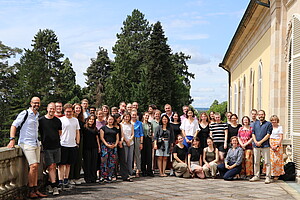
The last day of the conference took place in the imposing Aula and Balcony Room of Hohenheim Castle. The morning sessions provided insights into “Policy design and public policy support” as well as “Negotiating conflicts in sustainable transformation”. After lunch, the grand finale of the conference took place when Matthew Hornsey gave his keynote speech on “The attitude roots of opposition to renewable energy”. Of course, we did not miss out on taking a picture on the castle’s balcony.
The high quality of the presentations was remarkable, which we had already anticipated after the high number of outstanding submissions – apologies to all the colleagues we had to reject unfortunately. Especially, the large portion of early career scholars makes us confident that research at the intersection of social and environmental psychology is thriving and will become even more visible in the future. All participants agreed that the format of this conference allowed for fruitful exchange and constructive discussions and that similar meetings should be organized in the future. It was reassuring to see that these discussions kept on during the subsequent EASP General Meeting in Strasbourg. We want to thank all participants for attending the conference and the European Association of Social Psychology as well as the University of Hohenheim for their financial support.